
สำนักงานนวัตกรรมแห่งชาติ (องค์การมหาชน)

การให้บริการของ NIA

ความเคลื่อนไหวของ NIA

ช่องทางในการติดต่อกับ NIA


NIA Drives STEAM4INNOVATOR to Cultivate the Next Generation of Innovators, Inviting the Public to Explore Global Models of Innovation Classrooms
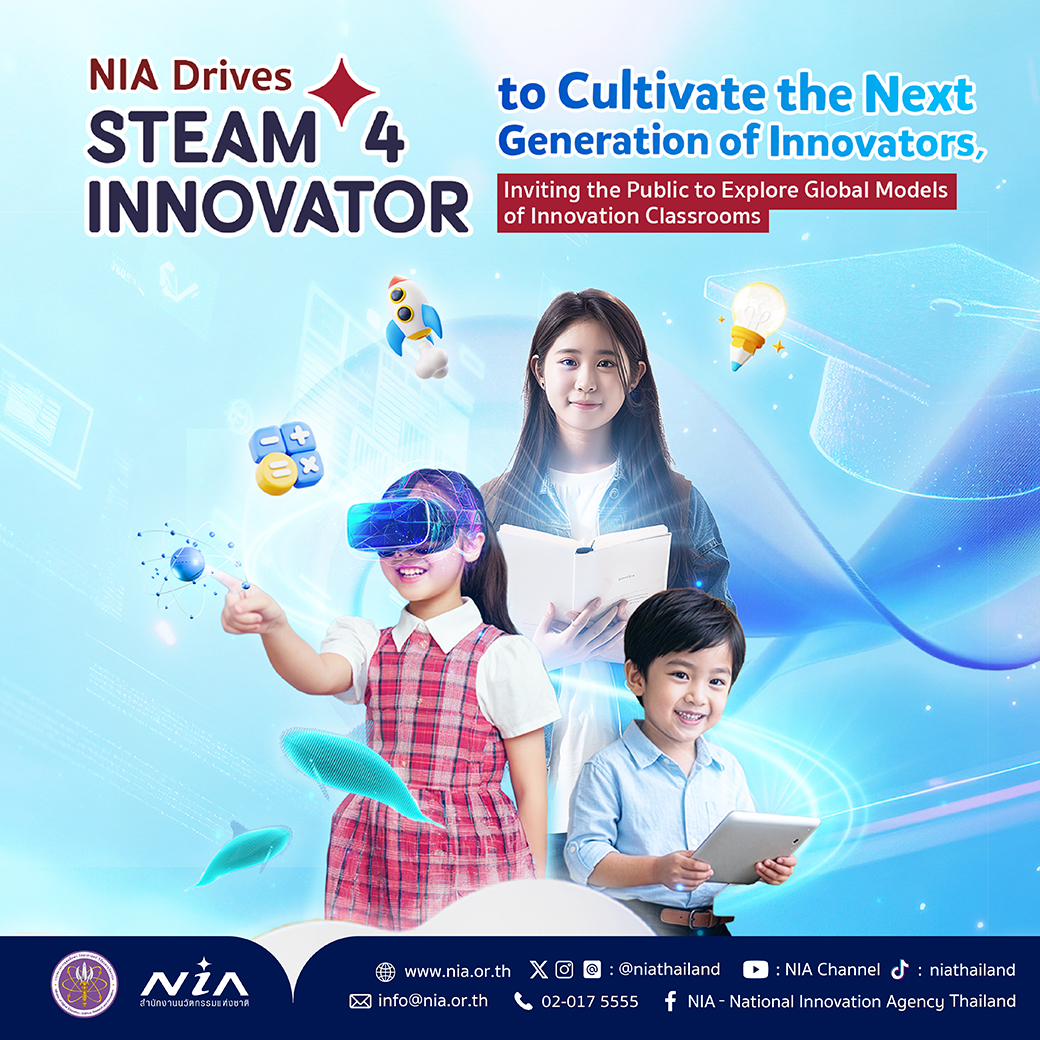
NIA Showcases Two World-Class Models of Innovation Classrooms, Driving STEAM4INNOVATOR Curriculum as Thailand’s Tool for Cultivating Young Innovators
The National Innovation Agency (Public Organization), or NIA, under the Ministry of Higher Education, Science, Research and Innovation (MHESI), continues to advance innovation skills among Thai youth through its STEAM4INNOVATOR curriculum — an innovation-creation process based on the principles of STEAM: Science, Technology, Engineering, Arts, and Mathematics, combined with systematic business thinking. The programme aims to nurture innovation and entrepreneurial skills in the next generation.
NIA also highlights two exemplary countries — Estonia and Singapore — as global role models for innovation-driven education. Both demonstrate that developing innovative thinking must begin at an early age to cultivate citizens with critical reasoning, creativity, and effective problem-solving abilities. Their success also reinforces that investment in education and teacher development is the cornerstone for building a generation equipped to compete in the future world.
Dr. Krithpaka Boonfueng, Executive Director of the National Innovation Agency, stated that the agency has been implementing youth-development initiatives for over eight years through a systematic collaboration network involving schools, universities, and both public- and private-sector partners. The STEAM4INNOVATOR process was designed as a hands-on tool to stimulate creativity and innovation among more than 10,000 young people nationwide. Developed from over a decade of experience working with Thai innovation entrepreneurs, the model offers a structured, easy-to-learn framework consisting of four key stages: 1) Insight (Understanding deeply and comprehensively); 2) Wow Idea (Generating creative and original concepts); 3) Business Model (Developing a concrete plan for commercialisation); and 4) Production & Diffusion (Producing and distributing the innovation).
Dr. Krithpaka explained that, globally, many countries view the younger generation as a crucial driving force in becoming innovation nations. Hence, they focus on nurturing potential from early childhood through university and young-adult stages — building a robust innovation ecosystem to drive national progress. Two notable models illustrating this vision are Estonia, a small country thriving through innovation, and Singapore, the world leader in learning achievement.
• Estonia Despite its small size, Estonia is recognised globally for its excellence in both education and digital transformation. It ranked first in Europe in educational performance according to the PISA 2022 assessment and has established strong national policies promoting STEAM education from kindergarten through secondary school, including teacher training.
One flagship initiative is the ProgeTiger Programme, launched in 2012, which integrates robotics, programming, and hands-on learning. This programme equips children not only with coding skills but also with problem-solving, creativity, collaboration, and critical-thinking abilities.
At kindergarten level, teachers use digital media and tablets to introduce coding through fun activities. Primary students learn via Scratch, Kodu Game Lab, and LEGO Spike Prime, while also studying digital safety and integrating technology into subjects such as mathematics, physics, and biology.
Secondary and vocational students progress to advanced technical skills such as Python, JavaScript, cybersecurity, 3D graphics, robotics, and game or app development — helping them explore technology careers.
Recently, Estonia launched the AI Leap initiative to enhance AI literacy among students and teachers nationwide. The plan provides AI tools and skills to every school, with a target to offer free AI accounts to 58,000 students and 5,000 teachers by 2027. Students aged 16–17 are the first users, and teachers receive training in AI literacy, digital ethics, and AI-based lesson design — positioning Estonia as a testbed for AI adoption in education.
• Singapore is another global exemplar of STEAM-based education and innovation. Ranked first globally in the PISA 2022 assessment for science, mathematics, and complex problem-solving, Singapore has systematically invested in STEAM, coding, and robotics to prepare its citizens for a new-economy workforce.
Its Applied Learning Programme (ALP) encourages students to apply academic knowledge in real-life contexts, fostering innovation grounded in real-world issues and multidisciplinary integration. Rather than diluting academic rigour, ALP deepens conceptual thinking, encourages knowledge application, and inspires students to create positive community impact.
The STEAMunity initiative exemplifies public-private collaboration between schools, universities, and innovation hubs such as the Science Centre Singapore, building strong, sustainable educational ecosystems. Singapore also promotes Maker Spaces and Innovation Labs across all school districts, nurturing a makers’ culture that empowers learners to explore new fields, acquire new skills, and experiment creatively. Short courses and workshops are also offered for learners seeking in-depth expertise in specialised areas.
“From our long-term experience in youth development,” said Dr Krithpaka, “we have found that beyond core content, three essential components drive creative learning for the new generation — Curriculum, Pedagogy, and Vibe. These must work in harmony and be designed to make learning enjoyable, encouraging young people to express their creative energy confidently and sustainably.”
To broaden the impact nationwide, NIA is expanding its toolkit so that students, teachers, and educators can implement the STEAM4INNOVATOR approach in real classrooms. This includes resources such as the STEAM4INNOVATOR Canvas and the STEAM4INNOVATOR Virtual Learning Station, both aimed at developing creativity, problem-solving, and communication skills.
“The initiative also prepares youth for national and international innovation competitions, encouraging them to transform ideas into real businesses. NIA continues to scale the model across Thailand by training teachers and developing STEAM4INNOVATOR Centres — innovation hubs within schools designed to nurture young innovators continuously and sustainably from generation to generation.”
Dr. Krithpaka, stated NIA is also building a broader youth innovation ecosystem through collaboration with various educational and institutional partners, including The Office of the Education Council (ONEC), to replicate the successful transformation model that turns schools into innovation hubs for youth; The Institute for the Promotion of Teaching Science and Technology (IPST), to design science- and technology-based innovation textbooks; The Office of the Vocational Education Commission (VEC), to develop curricula for innovation entrepreneurs; The Office of the Basic Education Commission (OBEC), to create learning media for teacher development; and The Office of the Permanent Secretary, Ministry of Higher Education, Science, Research and Innovation (MHESI), to build a nationwide network of ‘Innovator Teachers’.
Additionally, NIA has partnered with Chulalongkorn University to design learning processes for early childhood and children aged 4 to 15, ensuring inclusive access to innovation education at every stage of youth development.
Looking ahead, NIA plans to extend its education-based initiatives toward innovation-career development, working with relevant agencies to establish professional systems aligned with international standards. This includes strategies to develop the national workforce’s innovation skills through collaboration with MHESI, universities, and private-sector partners to strengthen Cooperative and Work-Integrated Education (CWIE), emphasising innovation creation and business co-development with entrepreneurs.
NIA is also collaborating with the Thailand Professional Qualification Institute (Public Organisation) to enhance innovation competencies across professions and to establish professional standards for Innovation Management Executives, who will play a crucial role in future industrial and business sectors.
“All these efforts reflect NIA’s strong commitment to building a lifelong learning society, enhancing innovation skills and competencies among Thai youth in a systematic way, and ultimately propelling Thailand towards becoming a true Innovation Nation,” concluded Dr Krithpaka.